AI agent, chatbot or script: what does your SME need?
Updated on 29 June 2026
A chatbot talks, an AI agent acts and a script follows fixed rules. Which of the three your SME needs comes down to one question: does the task always run the same way? Then the script wins, because it is cheaper, faster to build and predictable. An agent only gets interesting once the task asks for judgement and variation.
| Type | What it does | When to pick it |
|---|---|---|
| Script | Follows fixed if-then rules | The task always runs the same way |
| Chatbot | Answers questions from your documentation | People are looking for an answer |
| AI agent | Takes action in your systems itself | The task asks for judgement and variation |
What is an AI agent?
An AI agent is software that takes steps on its own to reach a goal: looking things up, driving your systems and working out for itself which intermediate steps are needed. Where a chatbot answers questions, an agent carries something out. It reads the request, pulls up the customer details, drafts a quote and puts it ready for approval.
What is the difference between a chatbot and an AI agent?
A chatbot is a conversation window that answers questions from your documentation or a knowledge base, and that is where it stops. An agent sits at the controls of your systems and takes action. That makes agents more useful and riskier at the same time: a wrong answer is annoying, a wrong action costs money. Agents are also not deterministic. The same input can produce a slightly different outcome, and your process has to be able to absorb that.
When is a plain script enough?
More often than the market would like you to believe. If a colleague can write the task out as a series of if-then rules, build a classic automation: testable, predictable and a fraction of the price. Putting an agent on pure rule work is an expensive detour to the same result.
Be wary too of what Gartner calls "agent washing": ordinary automations sold as agents. Gartner also predicts that more than 40% of agentic AI projects will be scrapped by the end of 2027 because of rising costs or unclear value. The technology itself is sound. It is the selling that happens at every possible opportunity.
Which tasks can you hand an agent today?
Tasks with variation, where a person currently strings loose steps together. Work that asks for judgement but has a fixed goal. That is exactly the territory of agents and RPA. Three examples that are realistic for an SME:
- Quote preparation: reading the request, pulling in customer history and price lists, and putting a draft ready.
- From email to action: turning an incoming question into a file, a task or a proposed appointment in your calendar.
- Meeting preparation: bringing together the relevant documents, figures and open points before every meeting.
You are in good company: according to McKinsey, 62% of organisations are experimenting with agents. The same figures carry the flip side: only a fraction get them into structural use.
Who approves? The three levels of oversight
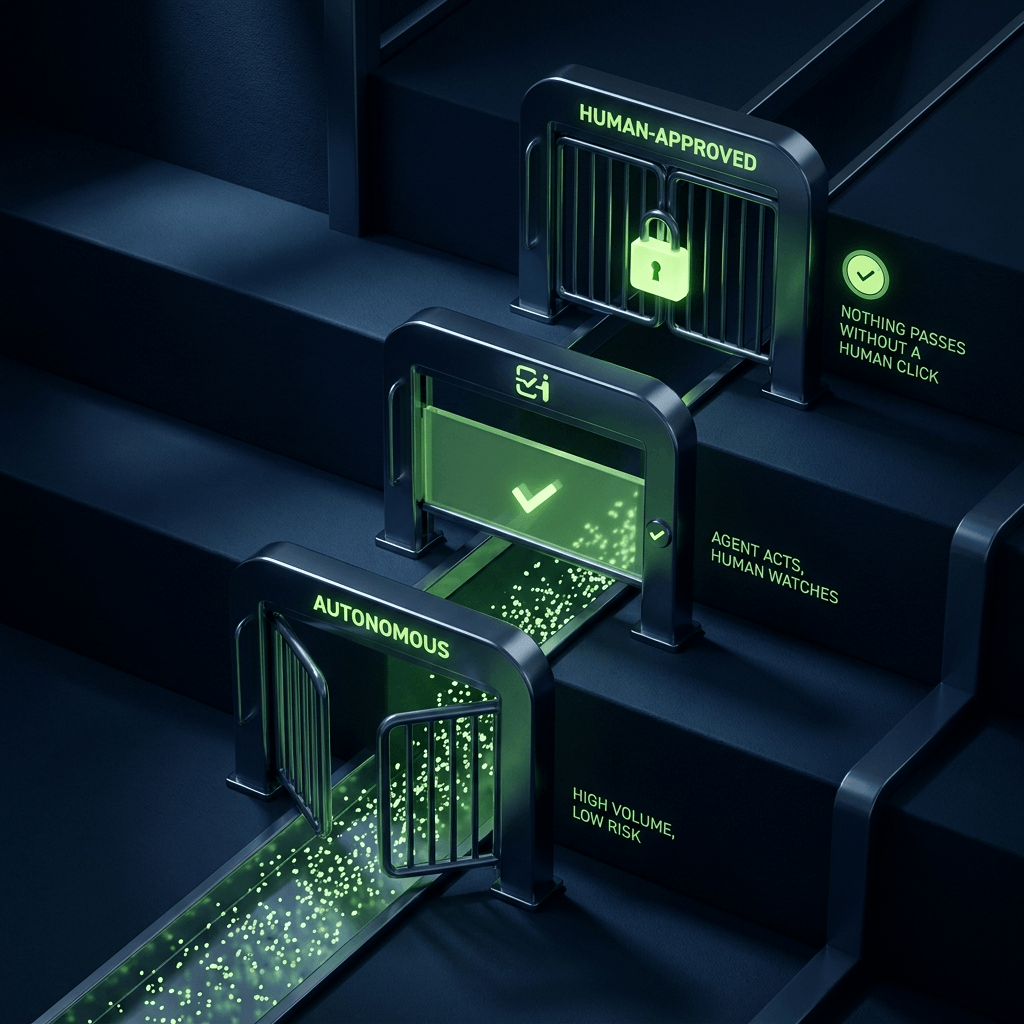
A human does, and how much that human sees is something you decide per task. Set the agent's autonomy up front: the more a task touches money, commitments or customer communication, the firmer the human oversight. Three levels help you choose:
- The agent proposes, a human approves. For anything touching money, commitments or customer communication. The quote leaves only after a human click.
- The agent acts, a human watches. For reversible tasks: labels, drafts, internal summaries. Spot checks and an undo button are enough.
- The agent works autonomously within fixed limits. Only for high volume and low risk, with hard limits on what it may touch.
Start every agent at level one and let it earn autonomy with results, an approach we work out more broadly in implementing AI in your business. That matches how little trust there is today: in a survey cited by Harvard Business Review, a mere 6% of companies say they would trust an agent with a core process without oversight.
What does an AI agent cost?
More than a script, less than a software platform, and the build is only half the story. Count on a few weeks of building for a first agent, plus something scripts never need: ongoing supervision. Someone has to follow the output, adjust the limits and step in when the behaviour drifts. A quote that stays silent about that supervision is incomplete.
One obligation to take with you: put a chatbot or agent in front of customers and from 2 August 2026 it has to be clear that they are talking to AI. What that involves is in our article on the AI Act.
Not sure whether your task deserves a script, a chatbot or an agent? Often a simple script is enough, and we will tell you so honestly. Describe the task in a few sentences through the contact form and we will tell you which of the three it becomes, and why.
Frequently asked questions
- When is an ordinary script enough instead of an AI agent?
- If the task always runs the same way and you can capture it in fixed if-then rules, a classic automation will do. It is testable, predictable and a fraction of the price of an agent. Putting an agent on pure rule work is an expensive detour to the same result.
- How much autonomy do you give an AI agent?
- Decide that per task, with three levels: the agent proposes and a human approves, the agent acts and a human watches, or the agent works autonomously within fixed limits. Always start at the first level and let the agent earn autonomy with results. Anything touching money, commitments or customer communication leaves only after a human approval.